Week 4: Proposal Critiquing
DATA 510: Data Science Capstone
Abstract
Week 4: how to critique an M1 project proposal using the official rubric and required sections. In-class activity: solo read of a practice Oregon wildfire-smoke proposal, group critique and report-out, Canvas participation roster. Prepares you for your own proposal due this week.
Learning Objectives
Today’s Objectives
What You Will Leave With
By the end of this session, you will be able to:
- Use the M1 proposal rubric as a checklist when you read someone else’s plan (or your own draft).
- Separate merit (what is strong and worth keeping) from shortcomings (what would block my approval or hurt you at M2 through M5).
- Critique research questions, charter alignment, scope, feasibility, and DS3 readiness with evidence from the document.
- Participate in a structured group report-out and submit your group’s roster on Canvas.
Part 1: Why We Critique Proposals
Proposal Critiquing
Your M1 Proposal Is the Term Roadmap
The project proposal is worth 9% of your final grade. More importantly, it is the default roadmap for scope and priorities from week 4 through week 14.
I read it the way your peer Stakeholder POs read a Studio Critique: specific, evidence-based, tied to what you committed in CHARTER.md.
. . .
If the proposal is vague, I send it back. If it overpromises, you will feel it at M2-data-summary when the data pipeline is still on fire.
What Tonight Is (and Is Not)
Tonight: practice critiquing a sample proposal I wrote for this activity. Not a classmate’s work. Realistic enough that the skills transfer to your M1 due this week.
. . .
Not tonight: grading your actual proposal. Not a beauty contest. Not “tear it apart” theater.
. . .
Goal: name merit and shortcomings the way a serious reviewer would, so you can fix your own draft before you upload the PDF.
The Spec You Are Practicing Against
Authoritative requirements:
- Project Proposal (M1)
- DS3 framework
- Your committed
CHARTER.mdin your repo
Ten required sections. Six rubric criteria. One coherent story.
Part 2: The Rubric as Your Lens
Rubric and Sections
Six Criteria, One Document
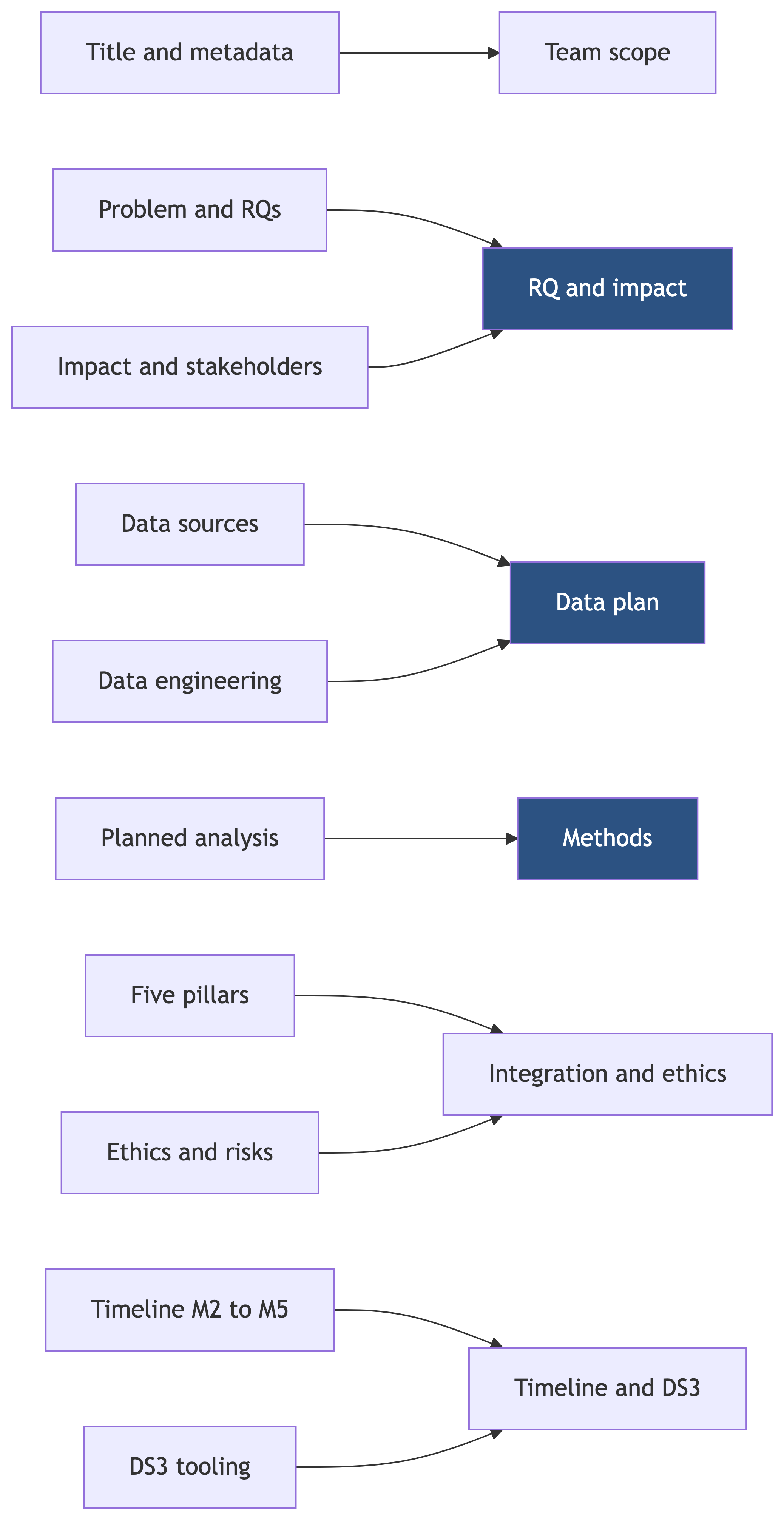
When I score your proposal out of 100, I use these buckets (see the assignment page for full wording):
| Rubric criterion | Points | What I am really asking |
|---|---|---|
| Research question and impact | 20 | Testable question; consequential problem; charter consistency |
| Data plan and approval | 20 | Named sources; approval status; credible engineering plan |
| Methods and evaluation | 20 | Methods match the question; baselines; criteria of acceptance (COA) on product backlog items (PBIs) |
| Integration and ethics | 15 | Five pillars substantive; ethics tied to the setting |
| Timeline, feasibility, DS3 | 15 | M2 through M5 realistic; repo, board, Discord live |
| Team scope (if applicable) | 10 | Team of 2 or 3 shows commensurate scope and labor split |
Map Sections to Criteria
When you critique, you can walk the document section by section and ask which rubric row each section supports or undermines.
When I Score Data Plan and Approval
I look for:
- Every source named with a URL or API doc link.
- Volume and refresh cadence (rough estimates are fine if honest).
- Instructor approval status: requested, approved, or pending. At this stage, this mostly applies to the projects brought to Capstone from external sources or those ahead of schedule.
- A credible plan for
data/raw/,data/interim/,data/processed/in the DS3 template layout.
. . .
“We will find data later” is not a plan. 👀
When I Score Methods and Evaluation
I look for:
- Methods that could answer the stated question (not just impress me).
- Baselines and metrics named before you build the fancy model.
- Major analytical steps mapped to PBIs with a Create / Observe / Analyze triple.
. . .
Guidance examples:
- If the question is association at county level, say how you will handle confounding.
- If the question is forecast, say the horizon and how you will validate.
Charter Consistency (Non-Negotiable)
Your proposal should match the Vision and Mission in CHARTER.md. If it does not, update your charter to match the proposal.
. . .
A charter that says one thing and a proposal that says another is a trust problem. Your peer POs will probably notice before I do.
🧠 Quick Quiz: Charter vs Proposal
A team’s charter mission says they will build an evacuation routing dashboard for rural Oregon. The proposal body focuses on pediatric asthma claims and county-level smoke exposure. No “what changed” paragraph.
What is the best critique?
A. Strong pivot; charters are disposable.
B. The topic is still Oregon, so alignment does not matter.
C. Blocking issue: charter and proposal disagree; needs reconciliation or explicit change log.
D. Only the Owner Product Lead should care.
. . .
C. Peer POs and I need one north star. Fix the charter, fix the proposal, or document the pivot with reasons.
Part 3: How to Critique Like a Peer PO
Critique Norms
Merits First
Start with what is strong enough to keep:
- Quote or point to the section.
- Tie it to the rubric (“this stakeholder paragraph supports impact”).
- Be specific: “Section 4 names EPA AQS with daily refresh” beats “good data section.”
Merit-first critique is how you earn trust before you deliver hard news.
Shortcomings That Matter
Then name what would make me (or an employer) pause or send the proposal back:
- Blocking: wrong data approval story, charter mismatch, methods that cannot answer the question, team of 3 with solo scope.
- Revision: vague ethics, thin five pillars (data engineering, analytics/ML, visualization and communication, ethics and responsible use, and statistics/research design), timeline that skips M2 work.
- Polish: typos, formatting. Mention it last.
Report-Out Buckets (Your Group Agenda)
When I put you in groups, organize your discussion around:
- Overall merits and shortcomings
- Research questions (focus, testability, feasibility this term)
- Charter fit (vision, mission, success criteria vs proposal body)
- Scope and five pillars (integrated capstone vs silo pitch)
- Feasibility and timeline (M2 through M5 honest?)
One spokesperson per group will report out for 2 to 3 minutes using these buckets.
Part 4: Tonight’s Activity
In-Class Activity
Step 1: Solo Read (About 12 to 15 Minutes)
Open the practice proposal PDF:
Read it like you are my grader and a peer PO. Jot merits and shortcomings; use the rubric and the five buckets above.
This document is practice only. I wrote it for tonight. It is not anyone’s real capstone.
Step 2: Group Critique (About 20 to 25 Minutes)
I will assign groups. Compare notes. Agree on:
- One strongest merit (with evidence).
- One most serious shortcoming (blocking vs revision).
- Anything you would want fixed before your proposal goes to Canvas this week.
Step 3: Report-Out
Each group: one spokesperson, 2 to 3 minutes, hit the buckets you care about most. I may ask follow-ups.
Listen to other groups. If they name something you missed, that is the point.
Step 4: Canvas Roster
One person per group submits on Canvas (text box only):
- Submitter name
- Every teammate’s name (participation credit)
See the Canvas assignment page.
Part 5: Wrap-Up
Before You Finish Your Own Proposal
Your M1 Checklist (Abbreviated)
Before you submit your PDF:
Full checklist lives on the project proposal page.
Model exemplar (optional): Compare your draft to the model M1 proposal (PDF). Same Oregon topic, written to the Excellent band. Tonight’s practice PDF is intentionally weaker.
Before You Leave
Your real M1 proposal is due by the end of week 4 per the Canvas assignment. Questions on scope or data approval: #blockers on Discord or email me.
References
References
- Cordova, L. P. DATA 510 Project Proposal (M1 milestone). https://willamette.instructure.com/courses/10056/assignments/124616
- Cordova, L. P. DATA 510 DS3 Project Framework. https://courses.lpcordova.phd/data510/project-framework/
- Liu, J. C., et al. (2016). Wildfire-specific fine particulate matter and risk of hospital admissions in urban and rural counties. Epidemiology, 27(3), 350-357.
- U.S. Environmental Protection Agency. Air Quality System (AQS). https://www.epa.gov/aqs
- Centers for Disease Control and Prevention. PLACES: Local Data for Better Health. https://www.cdc.gov/places